
West Austin seamless gutters
Gutter Installation in Austin, TX
Seamless gutters and downspouts sized to your roof and to the way Austin rain actually falls: hard and fast. Then routed so the water leaves your foundation, your beds and your neighbor alone.
Move the storm with your mouse (tap on a phone). Watch the gutter carry it to the downspouts.
Why it matters here
Austin doesn’t get much rain. It gets it all at once.
About 36 inches a year at Camp Mabry sounds modest. The problem is how it arrives: May averages about 5 inches and October about 3.9, much of it in short bursts. A 2,000 sq ft roof sheds about 1,250 gallons per inch. A gutter sized for a gentle national average overflows in the first minutes of an Austin storm.
What that water does depends on where you live. On clay (common east of I-35 and in parts of the metro), water dumped at the foundation during a storm, followed by weeks of dry heat, is the swell-and-shrink cycle foundation engineers warn about. On the west side, soils are thin over limestone and lots are steep, so the risk is erosion, washed-out beds and runoff crossing onto the neighbor. On tight infill lots under Austin’s HOME rules, a downspout that dumps into a 6-foot side yard puts water at two slabs at once.
Many new Austin homes come with no gutters or gutters on only part of the roof. Whatever the builder’s reason, the water still has to go somewhere. Whether your house needs gutters depends on your soil, overhangs and slope; our guide walks through it.
Where the water goes
A gutter only moves the problem if the downspout dumps at the corner.
We plan where each downspout discharges before we hang a single run. Pick an option to see what it does. Texas Water Code §11.086 makes it unlawful to divert surface water in a way that damages a neighbor’s property, so none of our outlets point at the property line.
Downspouts and drainage · Should downspouts be buried? · Can they drain to the street in Austin?
Services
Sized from the roof, not from a brochure.
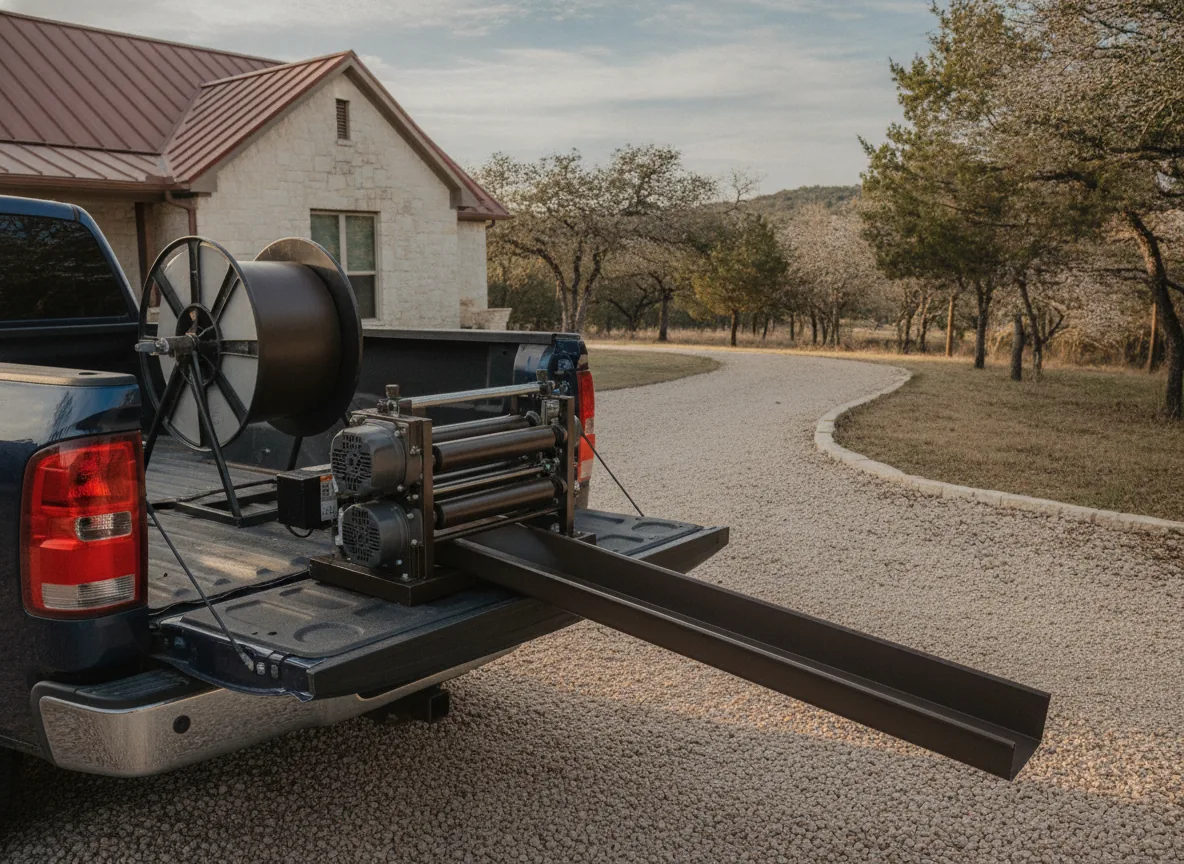
Roof area and pitch for each section, rainfall intensity from NOAA Atlas 14 for Austin, 5-inch or 6-inch K-style with enough outlets, pitch toward each one. Every run formed on site from coil, so there are no seams along the length to leak.
Seamless gutter installation
Formed on site from coil, sized to your roof and to Austin rain.
Gutter replacement
Tear-off of sagging or undersized runs, fascia checked, a right-sized system.
Gutter guards
Matched to your trees, with honest talk about tassels, pollen and upkeep.
Gutter repair
Leaks, sagging runs, pulled hangers, bad pitch, failed end caps.
Gutter cleaning
Troughs and downspouts cleared and flushed, problems flagged.
Downspouts and drainage
Extensions, buried lines and pop-ups that move water off the slab.
Fascia and soffit repair
Rotted fascia replaced before new gutters go back up.
Copper and half-round gutters
For older homes and custom builds that deserve the profile.
Rainwater collection gutters
Gutters and downspouts set up to feed barrels or a cistern.
Hail and storm damage gutter repair
Documented, photographed and replaced after hail or wind.
Commercial gutters
Bigger profiles and downspouts for commercial and multifamily roofs.
Try it
Will your gutter keep up?
Most sizing charts assume 1 inch of rain an hour. Austin’s 2-year, 5-minute burst is about 6.3 inches an hour and the 10-year burst 9.6 (NOAA Atlas 14, Camp Mabry). Set up one gutter run and see whether it overflows. The math: inflow in gallons per minute = 0.0104 × roof area × rainfall rate, split across the downspouts on that run.
Basis: the common rule of thumb that a level 5-inch K-style gutter with one outlet handles about 5,520 sq ft of roof at 1 in/hr, and a 6-inch about 7,960. Real runs have pitch, debris, inside corners and roof valleys, so treat “barely” as “no”. Inflow this moment: 0 gal/min. Full method in 5-inch vs. 6-inch gutters for Austin; the step-by-step sizing math posts Nov 3.
The Austin calendar
Trees, hail and freezes decide when gutters clog.
Live oaks drop leaves and tassels mostly in March and April, right before the wettest month. Hail peaks March to May. Cedar elms and pecans drop in fall, ahead of October. Camp Mabry averages about 12 days a year at or below freezing. The bars are the 1991–2020 monthly rainfall normals in inches.
Hover or tap a month to see what lands in the gutter.
Sources: NWS Austin/San Antonio climate normals; Texas A&M Forest Service on oak timing; NOAA storm reports for hail. If you’re thinking about gutter guards, the tree list on your lot matters more than any brochure. Month by month: your Austin gutter calendar.
Where we work
A West Austin installer serving the whole metro.

The west side
Limestone, thin soil, steep lots. Runoff and erosion are the enemy.
- West Lake Hills
- Rollingwood
- Lakeway
- Bee Cave
- Steiner Ranch
- Barton Creek

Central Austin
Older homes, big trees, box gutters and tight infill lots.
- Tarrytown
- Barton Hills
- Circle C
- Oak Hill
The metro
Clay soil, new builds without gutters, hail country.
- Round Rock
- Cedar Park
- Leander
- Georgetown
- Pflugerville
- Kyle
- Buda
All 21 area pages: service areas.
What a quote looks like
Written, itemized, measured on site.
Texas has no state license for gutter installers. That makes the quote itself the place to judge a company. Ours lists every line, so you can compare it against anyone else’s.
- Linear feet, measured on site, by wall
- Gutter size, profile and metal thickness
- Number and size of downspouts, and where each one discharges
- Fascia repair priced separately, if we find rot
- Guards as their own line, only if you asked
- Photos before and after
After hail, we write up the damage with photos so you can file your claim. We don’t waive or rebate deductibles; Texas Business & Commerce Code §27.02 prohibits it without the insurer’s consent. We don’t do electrical work or roofing beyond drip edge, gutter apron, fascia and soffit.
FAQ
Questions Austin homeowners ask first.
Do I need gutters on my house in Texas?
Usually, yes. Without gutters, the roof drops water in a line at the foundation. On clay soil that feeds the swell-and-shrink cycle. On sloped lots it causes erosion. A house with large overhangs, a lot that slopes away on every side and sandy soil may get by, but that is rare in Austin.
Why do so many new Austin homes not have gutters?
Gutters are an easy line item for a builder to cut, and many buyers don’t notice until the first big storm. Many new homes here are built with no gutters or only partial gutters. Adding a full system later is routine work.
Are seamless gutters worth it?
For most Austin homes, yes. Seamless runs have joints only at corners, end caps and outlets, so there are fewer places to leak. They are formed on site to the exact length of each wall. Sectional gutters cost less in materials but have a seam wherever lengths join (commonly 10-foot pieces, sometimes longer).
Should I get 5-inch or 6-inch gutters in Austin?
It depends on roof area, pitch and how many downspouts the run can have. A 5-inch gutter is fine on many single-story roofs with short runs. Steep roofs, big roof planes and valleys that dump into one spot often need 6-inch gutters or extra downspouts. We size it from the roof, not from a default.
Why are my gutters overflowing if they’re clean?
The usual causes are a gutter that is too small, too few downspouts, bad pitch, or a valley pouring water over the front edge. A clogged downspout can also look like an overflowing gutter. See gutter repair for fixes.
How much does gutter installation cost in Austin?
It depends on linear feet, stories, material, downspouts, guards and any fascia repair. We quote in writing after measuring. Our gutter cost guide explains each factor and how to compare quotes.
More: the full gutter FAQ and the Austin gutter cost guide, with a spec checklist you can paste into any quote request.
Get a gutter estimate
Tell us about the house: how many stories, which sides have gutters now, and what problem you’re trying to fix. We’ll measure, size the system and give you a written quote you can compare line by line.