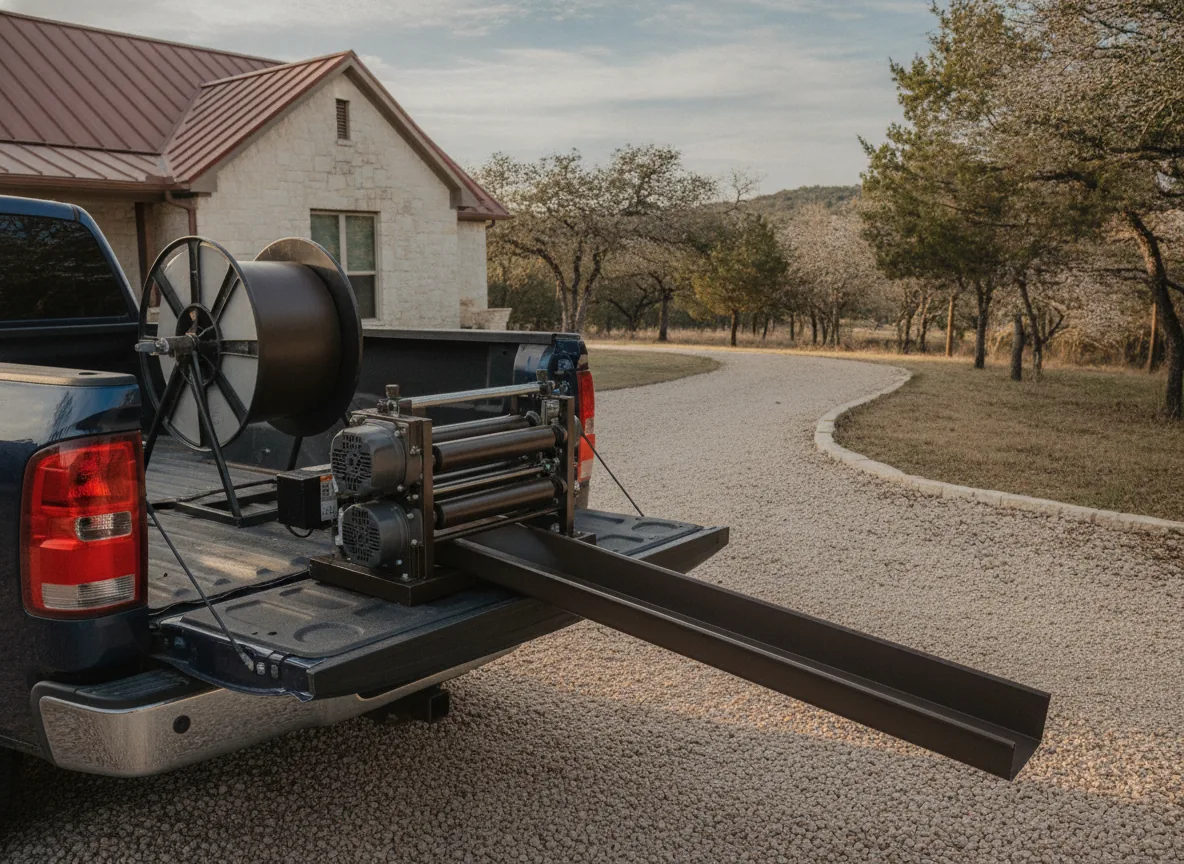
Seamless gutters are formed on site from a coil of aluminum into one continuous piece for each run of roof edge, so the only joints are at corners, end caps and outlets. In Austin, the bigger question is size: our storms dump water fast, and a gutter that looks fine in a drizzle can spill over in a May downpour. West Austin Gutters measures your roof, sizes the gutters and downspouts to it, and quotes the job in writing.
Seamless gutters vs regular (sectional) gutters
Sectional gutters come in pieces (commonly 10, 20 or 30 feet) joined with seams every few feet. Every seam is sealant holding back water, and sealant ages. Seamless gutters remove those joints along the run.
What that means for you:
- Fewer leak points. Leaks start at seams and corners. Seamless runs have seams only where the roof line turns.
- Cleaner look. No joint lines every 10 feet, and the gutter follows the fascia in one straight line.
- Custom fit. Each piece is cut to the measured length, not pieced together from stock lengths.
Sectional gutters still have a place: a small shed, a quick patch on a matching older system, or vinyl DIY work. For a house, seamless aluminum is the standard choice.
How we install seamless gutters
1. Measure every roof plane
We measure each run of eave and the roof area that drains into it. A long run under a valley handles far more water than the same length under a small gable. We also note roof pitch, because a steep roof sheds water faster and harder into the gutter.
2. Size to Austin rain: 5″, 6″ or 7″
Gutter size should match how much water arrives in a short burst, not the yearly total. NOAA’s Atlas 14 puts a 5-minute burst at Camp Mabry at roughly 6.3 inches per hour in a typical two-year storm and about 9.6 inches per hour in a 10-year storm. That is the kind of rate that overruns an undersized gutter.
- 5-inch K-style: fine for small roof sections, low pitch and short runs.
- 6-inch K-style: what we recommend for most Austin houses with valleys, steeper roofs or long runs. It holds more water and takes larger downspouts.
- 7-inch K-style: for big roof areas feeding one run, steep or tall roofs, and light commercial buildings.
3. Choose the metal: .027 or .032 aluminum
Thickness matters more than most quotes show. .027-inch aluminum is common on houses. .032-inch is about 18% thicker and stiffer, which matters most on 6- and 7-inch profiles. No thickness makes a gutter hail-proof. We list the gauge on every quote so you can compare quotes fairly.
4. Hang it with hidden hangers
We use screw-in hidden hangers fastened through the gutter into the fascia board, typically about every 24 inches. We place them closer under valleys and where heavy debris or ladders load the gutter. Screws hold better than the old spike-and-ferrule method, which loosens as wood shrinks and swells.
5. Slope toward the outlets
Gutters need a slight fall toward each downspout, set to the gutter maker’s spec (gutter makers publish minimums from 1/4 inch per 10 feet to 1/16 inch per foot). On long runs we set the high point in the middle and slope both ways to two downspouts, so the drop isn’t visible from the street and water never has to travel too far.
6. Seal miters and end caps
The only joints are corners (miters), end caps and outlets. We rivet them and seal them with gutter-grade sealant on the inside, where water sits.
7. Size downspouts: 2×3 vs 3×4
A 3×4 downspout has about twice the nominal opening of a 2×3 (actual drainage depends on the whole system). Many leaks blamed on gutters are really downspouts that can’t drain fast enough. With 6-inch gutters we normally use 3×4 downspouts and add outlets so no single downspout serves too much roof.
8. Send the water away from the house
A downspout that dumps at the foundation just moves the problem. We finish each downspout with an extension, splash block, or a buried line to a pop-up emitter. See downspouts and drainage.
Why Austin houses need this done right
Fast, heavy rain. May is Austin’s wettest month at Camp Mabry at about 5 inches, and October is next at about 3.9. Much of that arrives in short, intense storms. Sizing for those bursts is the whole job.
Trees. Live oaks drop leaves and tassels mainly in March and April, right before the May rains. Cedar elms and pecans drop in fall. A gutter half full of debris overflows at a fraction of its rated capacity, which is why some homeowners pair new gutters with gutter guards.
Soil. Expansive clay is common east of I-35 and in parts of the metro. It swells when wet and shrinks when dry, and roof water dumped at one corner of a slab makes that movement uneven. The model building code (IRC R801.3, 2024 edition) calls for a controlled method of roof-water disposal where expansive soils are known to exist, such as discharging at least 5 feet from the foundation, or into an approved drainage system. Local amendments and how your city applies it vary.
Slopes and rock. West of town, thin soils over limestone and steep lots mean water runs fast and erodes. Downspout placement matters as much as gutter size.
Heat. Aluminum grows and shrinks with Texas summer heat. Solid hanger spacing, and expansion joints on very long runs, help keep it from buckling.
New homes without gutters. Many newer Austin homes were built with no gutters or only partial gutters over doors. Adding a full seamless system later is one of the most common jobs we quote.
What affects the cost of seamless gutters
Every quote is written and itemized after we measure: linear feet, gutter size and material, number of stories, downspouts, guards and any fascia repair are listed as separate lines.
The main factors:
- Total linear feet and the number of corners
- Gutter size (5″, 6″ or 7″) and metal thickness (.027 or .032)
- Number of stories and how hard the eaves are to reach
- Number, size and length of downspouts
- Removing and hauling away old gutters
- Fascia repair found during the job
- Add-ons such as gutter guards or buried downspout lines
Our full breakdown is on the Austin gutter cost guide.
When seamless isn’t the right call
- Your gutters are mostly sound. A gutter repair may fix a leaking corner or sagging section for much less.
- The fascia behind them is rotten. Fix the wood first. New gutters on soft fascia will pull loose. See fascia and soffit repair.
- You want a historic look. Copper or half-round gutters suit some older homes better than K-style.
- You’re replacing an old system. See gutter replacement for what changes when we take the old gutters off first.
FAQ
Are seamless gutters worth it?
For most houses, yes. They have far fewer seams to leak and are cut to fit your house. The extra cost over sectional gutters is mostly labor and the forming machine, and it usually pays back in fewer leaks and less resealing.
Should I get 5 inch or 6 inch gutters in Austin?
For most Austin homes, 6-inch. Our short, heavy storms overrun 5-inch gutters on larger roof sections and under valleys. 5-inch can work on small, low-pitch sections, and we’ll tell you where it does.
Is a 7 inch gutter needed in Austin?
Usually not on a house. A 7-inch gutter makes sense for very large roof areas draining to one run, tall steep roofs, or light commercial buildings. Most overflow problems are solved with 6-inch gutters and more or larger downspouts.
How long can seamless gutters be?
The machine can form a run as long as the roof edge. The practical limits are handling the piece on site and heat expansion. On very long runs we add an expansion joint and slope the run to downspouts at both ends.
Do seamless gutters need cleaning?
Yes. Seamless means fewer leaks, not fewer leaves. Under Austin trees, plan on cleaning at least once or twice a year, or add guards. See gutter cleaning.
Can seamless gutters be repaired?
Yes. A leaking corner can be resealed, a sag can be rehung, and a damaged section can be cut out and replaced with a matching piece joined by a sealed seam.
Do I need a license to install gutters in Texas?
Texas has no state license for gutter installers. That makes it more important to get a written quote listing gutter size, metal gauge, hanger type and spacing, and downspout size.
Get a seamless gutter quote
Quotes are free, written and itemized after we measure on site. We serve West Austin (West Lake Hills, Rollingwood, Tarrytown, Barton Hills, Bee Cave, Lakeway, Steiner Ranch, Oak Hill, Circle C, Dripping Springs) and the greater Austin metro from Georgetown to Kyle. We also work in West Lake Hills, Round Rock and Cedar Park.
Book a free gutter quote. We measure on site and send a written, itemized quote.