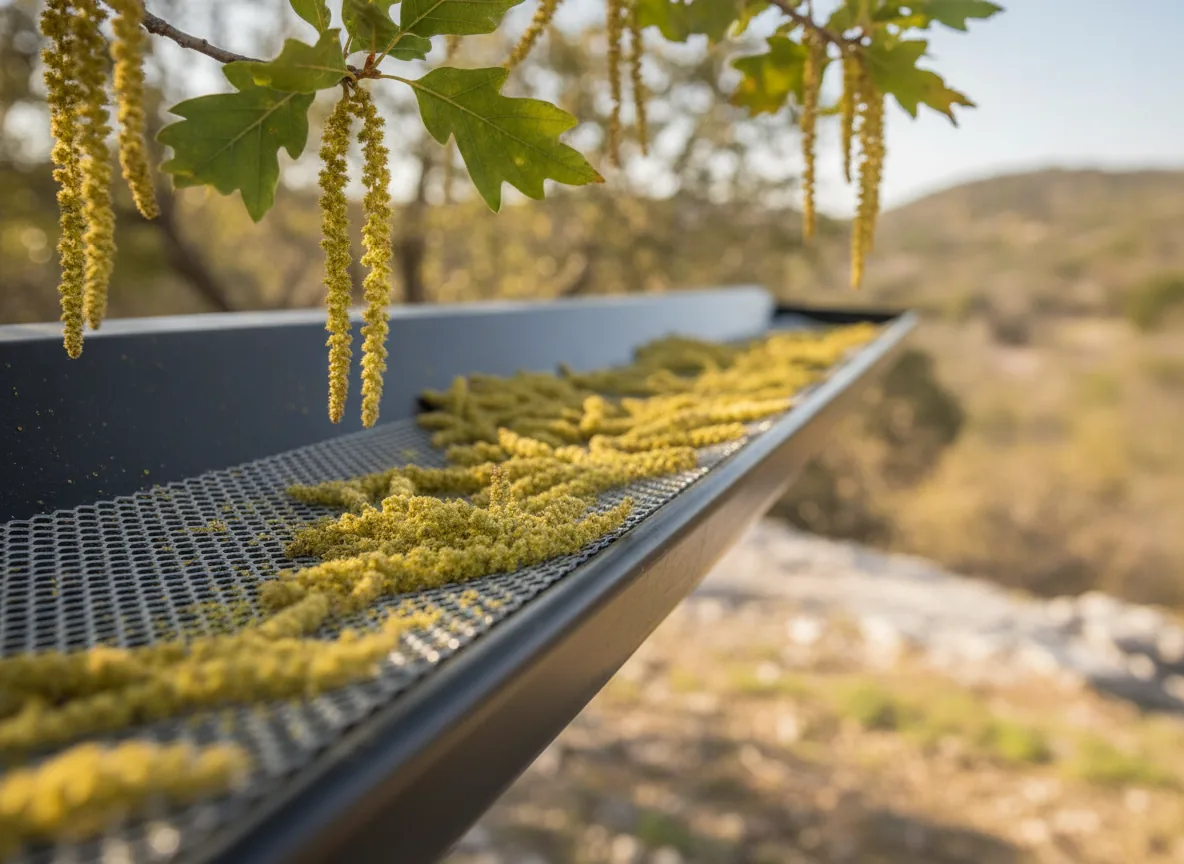
Gutter guards cut down how often you clean gutters, but none of them make gutters maintenance-free. Under Austin’s live oaks, fine micro-mesh guards keep out leaves but can get coated with oak tassels and pollen, and any guard can overshoot water in our heaviest storms. West Austin Gutters installs guards where they make sense, tells you where they don’t, and prices them in writing.
Are gutter guards worth it in Austin?
They’re worth it when:
- Trees hang over the roof and you’re cleaning more than twice a year
- The roof is two stories or steep, and every cleaning means a tall ladder
- Clogs have caused overflow, fascia rot or foundation splash in the past
- You’d rather pay once than schedule cleanings for years
They’re often not worth it when:
- No trees are near the roof and debris is light
- The gutters themselves are undersized, sagging or leaking. Fix that first. A guard on a bad gutter just hides the problem. See gutter repair.
- The quote is so high that years of gutter cleaning would cost less
The honest trade-offs
Most guard marketing skips these. You should know them before you buy.
Live oak tassels and pollen on micro-mesh
Live oaks drop leaves and long, stringy tassels (catkins) mainly in March and April, and pollen comes at the same time. Fine micro-mesh screens stop leaves well. But tassels lie flat on the mesh, and pollen plus rain can form a film over the holes. When that happens, water sheets across the top and off the front instead of dropping in. Expect to brush or rinse the top of a micro-mesh guard after the spring drop.
Overflow in heavy rain
Austin storms can rain very hard for a few minutes. NOAA’s Atlas 14 puts a 5-minute burst at Camp Mabry at about 6.3 inches per hour in a typical two-year storm and about 9.6 in a 10-year storm. In bursts like that, some water will skip past almost any guard, especially:
- Hood or “surface tension” guards, which depend on water curling around a lip
- Any guard under a valley, where water arrives in a concentrated stream
- Guards that sit too flat, or too steep, for the roof pitch
- Guards coated with debris or pollen
Some overflow in the worst storms is normal. Regular overflow in moderate rain means the guard, the gutter size or the downspouts are wrong.
Guards still need cleaning
“Never clean your gutters again” is not realistic. Small debris and roof grit still get through most guards and settle in the gutter. Debris piles on top of others. Plan on:
- Brushing or blowing off the top surface, especially after spring oak drop and fall leaf drop
- Flushing the gutters and downspouts every year or two
- Removing some guard types to clean underneath, which can mean added labor
Pricing
Gutter guard prices vary widely. Homeowners on forums post guard quotes from national companies of $8,000 to more than $21,000 (one 2024 r/Austin post reported $12,000) and ask if that’s normal. Some of those packages include new gutters, long warranties and financing. Get the price in writing, with the guard type, the linear footage and what the warranty actually covers, before you sign.
Gutter guard types, compared
| Type | How it works | Good at | Weak spots in Austin |
|---|---|---|---|
| Perforated aluminum screen | Rigid sheet with holes | Leaves, durability, cost | Small debris and tassels pass through or sit on top |
| Micro-mesh | Fine stainless mesh on a frame | Stops nearly everything | Pollen and tassel film; needs top cleaning |
| Hood / reverse curve | Water curls around a rounded nose | Big leaf loads | Overshoot in heavy rain; can’t see inside |
| Foam inserts | Foam fills the gutter | Cheap, DIY | Holds debris and moisture; breaks down |
| Brush inserts | Bristles sit in the gutter | Cheap, removable | Catches leaves and tassels; must be pulled to clean |
For most Austin homes under oaks, a sturdy perforated aluminum or micro-mesh guard on a properly sized gutter is the practical choice. We’ll recommend one based on your trees, roof pitch and gutter size.
How we install gutter guards
- Check the gutters first. We check slope, hangers, seams and downspouts. If the gutters are undersized or failing, we’ll say so. Sometimes the right answer is new seamless gutters with guards, sized right from the start.
- Clean and flush. Gutters and downspouts are cleaned before guards go on.
- Match the guard to the roof. We set the guard angle to the product’s instructions for your roof pitch so water drops in rather than shooting off.
- Attach without lifting shingles. We mount guards to the gutter lip and front edge. We don’t nail through shingles or pry them up to slide guards underneath.
- Plan for valleys. Where a valley dumps water, we may add a diverter or a second downspout so the guard isn’t overrun.
- Bigger downspouts. With 6-inch gutters we use 3×4 downspouts so water that gets in drains quickly.
Gutter guards for 6-inch gutters are widely available, and 6-inch gutters with guards are what we recommend for most heavy-tree lots.
Wildfire areas in west Austin
Austin adopted the 2024 Wildland-Urban Interface Code, and much of west Austin is in the WUI area. Dry leaves in gutters can catch embers. If you’re building or remodeling in the WUI, ask the city what applies to your project. We won’t tell you a product meets a code requirement unless we’ve confirmed it for your address.
What affects the cost of gutter guards
Every quote is written and itemized after we measure: linear feet, gutter size and material, number of stories, downspouts, guards and any fascia repair are listed as separate lines.
What drives the price:
- Linear feet of gutter
- Guard type and material (stainless micro-mesh costs more than perforated aluminum)
- Stories and roof pitch
- Whether gutters need cleaning, repair or replacement first
- Valleys, corners and complex roof lines
- Installing guards with new gutters vs retrofitting existing ones
See the Austin gutter cost guide for more.
FAQ
Do gutter guards really work?
Yes, at reducing how often gutters clog. They don’t eliminate cleaning, and no guard catches every drop in a heavy Austin storm. They work best on correctly sized gutters with large downspouts.
Why are gutter guards bad?
They aren’t bad, but they’re oversold. Common complaints are overflow in heavy rain, debris sitting on top, a film of pollen on fine mesh, extra cost to clean underneath, and very high prices from some sellers.
Do gutter guards need to be cleaned?
Yes. Expect to clear the top surface after big leaf or tassel drops and to flush the gutters every year or two. How often depends on your trees.
Do gutter guards work in heavy rain?
Mostly. In short, intense bursts, some water can skip past, especially at valleys and with hood-style guards. Regular overflow in moderate rain points to a sizing or installation problem.
Why are gutter guards so expensive?
Labor, warranty terms, financing and sales costs all sit inside a guard price alongside the material. That’s why written quotes listing guard type and footage are the only fair way to compare.
Which gutter guards are best for live oaks?
No independent test has compared guards under Austin live oaks, but rigid perforated aluminum or micro-mesh set at the maker’s recommended angle is easier to brush clean than foam or brush inserts. Plan on brushing off tassels and pollen in spring. Foam and brush inserts tend to trap oak debris.
Can I add gutter guards to my existing gutters?
Usually, if the gutters are sound, sloped correctly and well attached. If they sag or leak, guards add weight and hide problems, so fix or replace the gutters first.
Get a gutter guard quote
Quotes are free, written and itemized after we measure on site. We serve West Austin (West Lake Hills, Rollingwood, Tarrytown, Barton Hills, Bee Cave, Lakeway, Steiner Ranch, Oak Hill, Circle C, Dripping Springs) and the greater Austin metro from Georgetown to Kyle. We install guards in West Lake Hills, Tarrytown, Steiner Ranch and across the metro.
Book a free gutter quote. We measure on site and send a written, itemized quote.