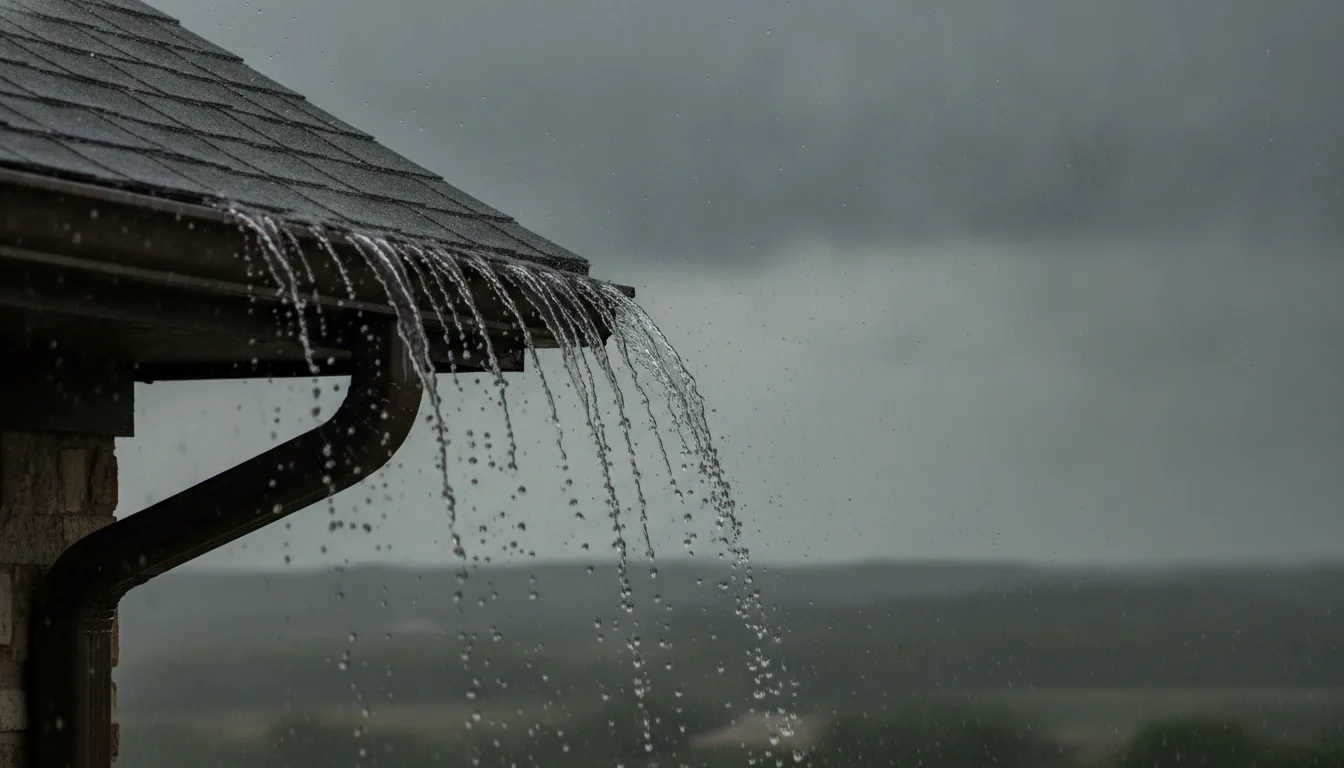
Commercial roofs move a lot of water to a few points, so the drainage has to be sized to the storm, not the building’s looks. That means box gutters or large K-style runs on pitched roofs, scuppers and conductor heads on flat roofs with parapets, and downspouts big enough to drain them. West Austin Gutters installs and repairs gutters, scuppers and downspouts on light commercial and multifamily buildings, and every job starts with a written scope.
What counts as commercial gutter work
- Retail, office and restaurant buildings with pitched roofs or parapet walls
- Multifamily buildings: duplexes, small apartment buildings and townhome rows
- Churches, schools and community buildings with long eaves
- Warehouses, shops and metal buildings with long, low-slope runs
- Covered walkways, canopies and porticos that drip on entrances
We focus on gutter and roof-drainage components. Roof membranes, roof decks and internal roof drains are roofing and plumbing work, and we’ll tell you when a job needs those trades.
Commercial gutter systems we install
Large K-style seamless gutters
On pitched roofs, 6-inch and 7-inch K-style seamless gutters in .032-inch aluminum cover many light commercial buildings. Heavier gauges are used where spans, ladders or hail call for them. They’re formed on site in continuous runs.
Box gutters
A box gutter is a square or rectangular gutter, wider and deeper than residential profiles. It carries much more water and suits long eaves, large roof areas and metal buildings.
- Exterior box gutters hang on the face of the building like a large K-style.
- Built-in (internal) box gutters sit inside the roof edge or behind a parapet. They’re common on older buildings and some modern designs. When they leak, water goes into the building, so lining, seams and overflow matter more.
Box gutters are custom-sized to the roof area. We size width and depth for the water they must carry and add an overflow so a blocked outlet doesn’t push water inside.
Scuppers and conductor heads
On flat roofs with parapet walls, water leaves through scuppers: openings through the parapet. A conductor head (collector box) on the outside catches scupper water and feeds a downspout. We install and replace scuppers, conductor heads and the downspouts below them, and add overflow scuppers set above the primary outlet so water has a way out if the main drain is blocked.
Large downspouts
Residential 2×3 and 3×4 downspouts are often too small. Commercial jobs typically use 4×5 rectangular or larger round downspouts, secured with heavy straps where they’re exposed to traffic, carts or vehicles. Boots or guards at the base protect them near parking and loading areas.
How we size commercial drainage for Austin storms
Commercial drainage should be sized to the short, intense bursts Austin actually gets. NOAA’s Atlas 14 puts a 5-minute burst at Camp Mabry at about 6.3 inches per hour in a typical two-year storm, about 9.6 inches per hour in a 10-year storm, and about 13.5 in a 50-year storm. The design storm you choose is a decision for the owner, the architect or the building code that applies.
Our process:
- Measure the roof areas draining to each gutter, scupper or outlet, including walls that shed water onto the roof.
- Pick a design rainfall rate from NOAA data or the project’s drawings.
- Size gutters and outlets to carry that flow, and add downspouts so no outlet is overloaded.
- Add overflow paths for built-in gutters and parapet roofs.
- Plan the discharge at grade so water leaves the site the way the civil drawings or the lot allows. See downspouts and drainage.
If the building has engineered drawings, we work to them.
Long runs, heat and expansion
Commercial buildings often have runs of 50 feet or more. Long aluminum gutters grow and shrink with temperature, and Austin summers put them through big daily swings. On long runs we:
- Add expansion joints so the gutter can move without tearing seams or bending hangers
- Slope from high points to outlets at each end, or to several outlets along the run
- Space hangers closer on heavy or wide profiles
- Seal and rivet every joint with commercial-grade sealant
Austin conditions that matter on commercial buildings
Hail. Central Texas large-hail season peaks March through May, and fall storms happen too. On September 24, 2023, NOAA records hail up to about 4 inches in Round Rock and 2.5 to 3 inches in north and central Austin. Heavier-gauge metal is stiffer, though no gutter is hail-proof. See hail damage gutters.
Heavy rain months. May (about 5.0 inches) and October (about 3.9) are Austin’s wettest months at Camp Mabry. Clogged scuppers and undersized downspouts show up then, often as water at the entrance or inside the building.
Soil and slopes. Expansive clay east of I-35 and in parts of the metro moves with moisture. Concentrated roof water at one corner of a slab or a parking area adds to that. In western Travis County, steep lots and thin soils over limestone mean fast runoff and erosion.
Neighbors. Texas Water Code §11.086 bars diverting surface water in a way that damages another property. On tight commercial and multifamily lots, downspout discharge has to stay on site or go to an approved outlet.
Debris. Trees near parking lots and walkways fill gutters and scuppers. Scheduled gutter cleaning or gutter guards on the worst runs prevent most overflow calls.
Permits, insurance and access
- Permits. Whether a gutter or drainage job needs a permit depends on the city and the scope. Ask the building’s city or county office, or check the project’s permit set. We’ll work within whatever the project requires.
- Insurance certificates. Many property managers require a certificate of insurance before work starts. Ask any contractor for one and confirm it with the insurer.
- Licensing. Texas has no state license for gutter installers, so ask for a written scope listing materials, gauges, sizes, outlet counts and overflow details.
- Access and scheduling. Lifts, traffic control, tenant notices and after-hours work affect the plan and the price. We sort these out before work is scheduled.
What affects the cost of commercial gutters
Every quote is written and itemized after we measure: linear feet, gutter size and material, number of stories, downspouts, guards and any fascia repair are listed as separate lines.
Cost drivers:
- Linear feet and profile: K-style, exterior box or built-in box
- Metal and gauge
- Number of scuppers, conductor heads and downspouts
- Overflow scuppers and expansion joints
- Building height and lift or scaffold access
- Tear-off of old gutters and repair of damaged trim
- Work hours, tenant coordination and site protection
See the Austin gutter cost guide for how we price.
Repair or replace on a commercial building?
Repair when one scupper leaks, a conductor head is loose, a downspout is crushed, or a few seams are open. See gutter repair.
Replace when the system overflows in ordinary storms, seams fail along the run, built-in gutters leak into the building, or the gutters are badly hail-dented.
FAQ
What is the difference between box gutters and regular gutters?
Box gutters are square or rectangular and usually wider and deeper than residential K-style gutters. They carry more water and suit large roofs and long eaves. Built-in box gutters sit inside the roof edge and need a sound lining and an overflow.
What size are commercial box gutters?
There’s no single size. Box gutters are custom-made to the roof area and the design rainfall rate. Width, depth, outlet size and the number of downspouts are all calculated together.
What is a scupper with a downspout?
A scupper is an opening through a parapet wall that lets water off a flat roof. A conductor head on the outside collects that water and feeds a downspout to the ground.
Do box gutters leak?
Built-in box gutters can, usually at seams, outlets or a worn lining, and the water goes into the building. Regular inspection, clean outlets and an overflow scupper reduce the risk. Exterior box gutters leak like any gutter, at seams and corners.
Do long gutters need expansion joints?
Yes, on long runs. Aluminum moves with temperature, and Austin’s heat makes that movement large. Expansion joints let the gutter move without tearing seams or hangers.
Do you repair commercial gutters?
Yes. We repair leaking seams and corners, scuppers, conductor heads, damaged downspouts and sagging runs on light commercial and multifamily buildings.
Request a commercial gutter scope
Quotes are free, written and itemized after we measure on site. We serve West Austin (West Lake Hills, Rollingwood, Tarrytown, Barton Hills, Bee Cave, Lakeway, Steiner Ranch, Oak Hill, Circle C, Dripping Springs) and the greater Austin metro from Georgetown to Kyle. We quote commercial and multifamily gutter work in Round Rock, Georgetown, Cedar Park and across the Austin area.
Book a free gutter quote. We measure on site and send a written, itemized quote.