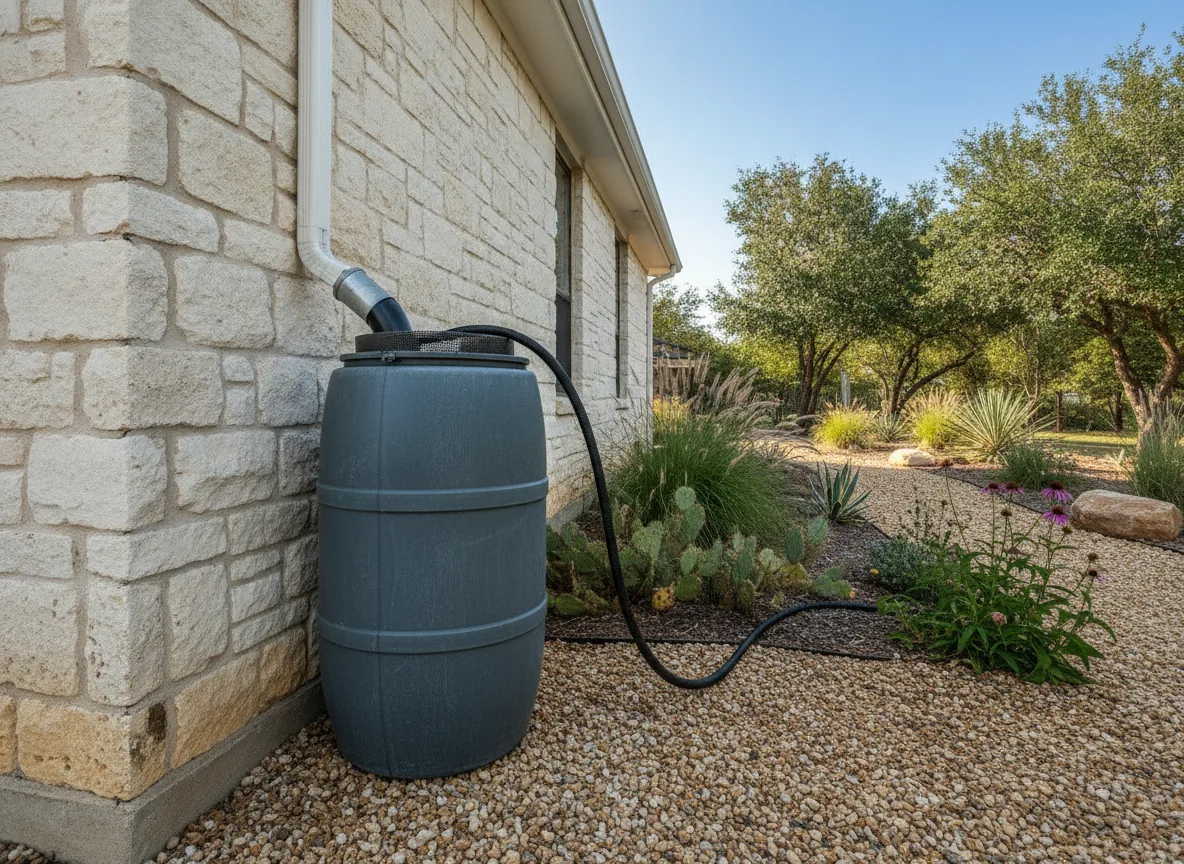
Rainwater collection starts with the gutters. Every inch of rain on 1,000 square feet of roof yields about 620 gallons, so the job is to route the right roof area to your tank, keep debris and the dirtiest first water out, and send the overflow somewhere safe. West Austin Gutters installs and modifies gutters and downspouts to feed rain barrels and cisterns. We don’t design potable (drinking) water systems.
The rain barrel math most people skip
The Texas Water Development Board’s rule of thumb: about 0.62 gallons per square foot of roof per inch of rain. That adds up fast.
| Roof area draining to one downspout | Gallons from 1 inch of rain (before losses) | A 55-gallon barrel fills after (no losses) |
|---|---|---|
| 200 sq ft | about 125 | about 0.45 inch |
| 500 sq ft | about 310 | about 0.18 inch |
| 1,000 sq ft | about 620 | less than 0.1 inch |
A single barrel under a big roof section is full in the first minutes of most storms. Austin averages about 36 inches of rain a year, with May (about 5.0 inches) and October (about 3.9) the wettest months at Camp Mabry and February and July are the driest (about 1.9 and 2.0). If you want water in July, you need storage sized to carry you through dry stretches, which usually means a cistern or several linked barrels, not one barrel.
How we set up gutters for rain barrels and cisterns
Route the right roof area
We look at which roof sections drain where. Sometimes the best move is re-sloping a gutter run so more roof drains to the downspout by the tank, or adding a downspout at the tank location.
Size gutters and downspouts for flow
A tank inlet can only take water as fast as the downspout delivers it. We use 6-inch gutters and 3×4 downspouts on runs feeding storage, so heavy bursts reach the tank instead of spilling over the gutter.
Screen debris at the top
Live oak leaves, tassels and spring pollen all wash into collected water. We install leaf screens or gutter guards on gutters feeding a tank, plus a screened downspout head or filter before the inlet. Pollen still gets through fine screens, which is one reason first-flush matters.
First-flush diverter
The first water off a roof carries dust, pollen, bird droppings and grit. A first-flush diverter catches that first portion in a separate pipe, then lets cleaner water flow to the tank. It drains itself slowly between storms. We size it to the roof area feeding it.
Overflow that goes somewhere safe
When the tank is full, water still comes. The overflow should leave through a pipe at least as large as the inlet, discharge well away from the foundation, and stay on your property. Texas Water Code §11.086 bars diverting surface water in a way that damages a neighbor’s property, so overflow aimed at the property line is a bad plan. See downspouts and drainage.
Mosquito-proof
Every opening gets screened. Standing water in an open barrel breeds mosquitoes quickly in Austin summers.
Texas rainwater laws that help you
Rain barrels are legal in Texas. There’s no state ban on collecting rainwater from your roof.
Your HOA can’t ban them. Texas Property Code §202.007 bars property owners’ associations from prohibiting rain barrels or rainwater harvesting systems. An HOA can still regulate some details, such as placement in front of the house, color and screening. Check your HOA’s rules before you choose a spot.
No sales tax on the equipment. Texas Tax Code §151.355 exempts qualifying rainwater harvesting equipment from state sales tax. Ordinary gutters and downspouts don’t automatically qualify; the item has to be used for harvesting. Ask your supplier how to claim the exemption when you buy.
Austin Water rebate. Austin Water offers a rainwater harvesting rebate for its customers, capped at $5,000 per site. Rates, eligibility and paperwork change, so check Austin Water’s current terms before you buy anything. Two things to know from the city’s published application: gutters themselves have been listed as an ineligible cost, and larger systems have needed pre-approval before purchase. If your water comes from a utility other than Austin Water, ask that utility whether it offers a rebate.
Rain barrels vs cisterns
- Rain barrels (50 to 100 gallons): cheap, easy, good for watering beds and pots between storms. They fill and overflow fast.
- Linked barrels: several barrels connected at the bottom act as one tank. A middle ground.
- Cisterns (hundreds to thousands of gallons): real storage for irrigation through dry spells. They need a level, solid pad and careful overflow design. Under the city’s published guidelines, systems over 500 gallons need pre-approval before you buy; confirm current terms with Austin Water.
We install and adjust the gutters, downspouts, diverters, screens and overflow piping that serve the tank. For tanks with pumps, pressurized systems or drinking water, you’ll need a rainwater system specialist or plumber.
What affects the cost
Every quote is written and itemized after we measure: linear feet, gutter size and material, number of stories, downspouts, guards and any fascia repair are listed as separate lines.
Cost factors for rainwater-ready gutters:
- Re-sloping or replacing gutter runs to route more roof to the tank
- Adding or moving downspouts, and upsizing to 3×4
- Leaf screens or guards on feeding runs
- First-flush diverters, filters and inlet screens
- Overflow piping and its discharge point, buried or above ground
- Whether you’re installing new gutters at the same time
See the Austin gutter cost guide for more.
When rainwater collection gutters make sense
- New gutters going on anyway. If your house has no gutters, as many newer Austin homes don’t, plan the downspout locations around the tank now. Moving a downspout later costs more.
- You water a garden by hand. Even a couple of barrels cover a lot of bed watering in spring.
- You want real storage. A cistern with proper gutters and overflow can carry a landscape through dry weeks.
If all you want is to keep water away from the foundation, start with downspouts and drainage instead.
FAQ
Are rain barrels legal in Texas?
Yes. Texas allows rainwater collection, and Texas Property Code §202.007 stops HOAs from banning rain barrels or harvesting systems. HOAs can regulate some placement and appearance details.
How many rain barrels do I need?
Do the math for your roof: about 0.62 gallons per square foot per inch of rain. A 500-square-foot section fills a 55-gallon barrel with less than a quarter inch of rain. Most people who want real storage end up with linked barrels or a cistern.
What is a rain barrel gutter diverter?
A diverter fits in the downspout and sends water to the barrel until it’s full, then lets the rest continue down the downspout. It’s the simplest way to add one barrel without changing your gutters.
What do I need on a gutter install for future rain barrels?
Plan the downspout locations where tanks will sit, use 3×4 downspouts, add leaf screens on feeding runs, and leave room for a first-flush diverter and overflow pipe. We can set that up during a seamless gutter installation.
Does Austin give a rebate for rain barrels?
Austin Water offers a rainwater harvesting rebate for its customers, capped at $5,000 per site. Terms change, and the city has listed gutters as ineligible, so check Austin Water’s current rules before you buy.
Is rainwater harvesting equipment taxed in Texas?
Usually not, for qualifying equipment. Texas Tax Code §151.355 exempts rainwater harvesting equipment from sales tax; ordinary gutters don’t automatically qualify. Ask the seller how to apply the exemption.
Get a rainwater gutter quote
Quotes are free, written and itemized after we measure on site. We serve West Austin (West Lake Hills, Rollingwood, Tarrytown, Barton Hills, Bee Cave, Lakeway, Steiner Ranch, Oak Hill, Circle C, Dripping Springs) and the greater Austin metro from Georgetown to Kyle. We set up rainwater-ready gutters in Dripping Springs, Bee Cave, Circle C and across the Austin area.
Book a free gutter quote. We measure on site and send a written, itemized quote.