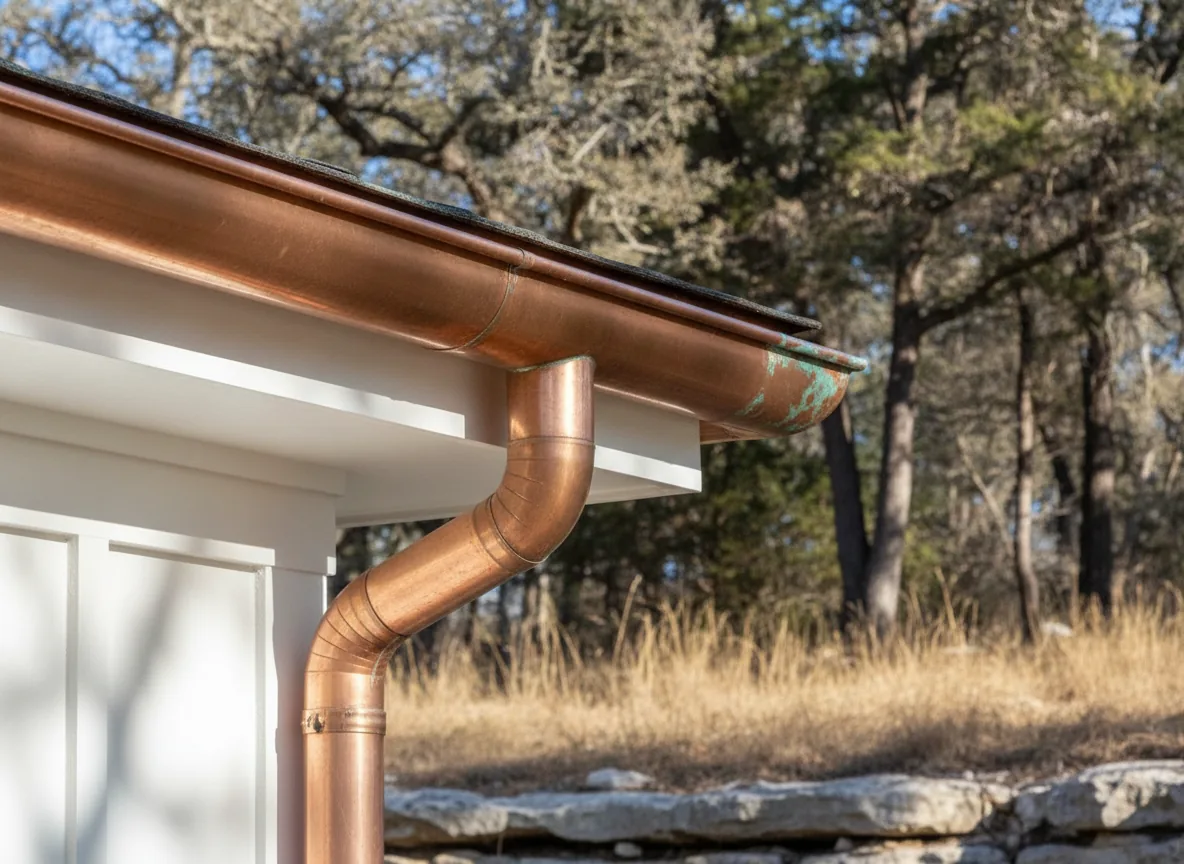
Half round gutters are semicircular troughs, usually paired with round downspouts. They’re the traditional look on older and high-end homes, and they come in copper or in painted aluminum that costs far less. The trade-off is capacity: a half round gutter carries less water than a K-style gutter of the same width, so in Austin’s heavy storms we size up and add downspouts. West Austin Gutters installs half round gutters in copper and aluminum.
What are half round gutters?
A half round gutter is a half-pipe hung along the roof edge with a rolled bead on the front lip. Compared with the flat-front K-style gutter on most houses:
- Look: a softer, classic line that suits historic, Tudor, colonial, Mediterranean and modern homes alike
- Cleaning: the smooth, rounded bottom has no inside corners for debris to pack into
- Capacity: less than K-style at the same width, because the round shape holds less water
- Hangers: hung on brackets, either exposed (visible below the gutter) or hidden
Half round gutters vs K-style
| Half round | K-style | |
|---|---|---|
| Look | Traditional, rounded | Flat face, looks like crown molding |
| Water capacity at same width | Lower | Higher |
| Common sizes | 5″, 6″ | 5″, 6″, 7″ |
| Downspouts | Round, 3″ or 4″ | Rectangular, 2×3 or 3×4 |
| Formed on site | Usually no; sectional lengths joined | Yes, seamless |
| Cost | Higher | Lower |
Half round gutters are usually sectional, joined with seams, rather than formed as one seamless piece. Those seams are soldered on copper and sealed on aluminum. If you want maximum capacity and the fewest seams, seamless K-style gutters are the better fit.
Sizing half round gutters for Austin rain
Austin rain arrives in bursts. NOAA’s Atlas 14 puts a 5-minute burst at Camp Mabry at about 6.3 inches per hour in a typical two-year storm and about 9.6 inches per hour in a 10-year storm. Because half round gutters hold less, we:
- Use 6-inch half round on most roof sections, and 5-inch only on small or low-pitch areas
- Add downspouts so each one serves less roof
- Use 4-inch round downspouts where a run carries a lot of water
- Watch valleys, where water arrives in a concentrated stream that can overshoot a rounded lip
Copper gutters: what to know
Weight and thickness
Copper gutters are sold by weight per square foot, commonly 16 oz or 20 oz. Heavier copper is stiffer and resists dents better. With Central Texas hail season peaking in March through May, we recommend the heavier weight on exposed runs.
Soldered seams
Copper is joined by soldering, not just sealant. Soldered seams and corners make a durable, watertight joint when done right. It’s slower, skilled work, which is part of the cost.
Never mix copper with aluminum or steel
Copper touching aluminum or galvanized steel causes galvanic corrosion, which eats the other metal. Copper gutters get copper brackets, copper straps, copper or compatible fasteners, and copper downspouts. Water that runs off copper shouldn’t drain into aluminum gutters below.
Do copper gutters turn green?
Copper darkens to brown within months of installation. The green patina (verdigris) develops over years and depends on rain, humidity and exposure. Some copper never turns fully green. If you want a specific color now, ask about pre-patinated copper, or clear-coating to keep the bright finish for a while.
Staining
Water from copper can stain light stone, stucco and concrete below with blue-green streaks. On homes with light limestone or stucco walls, we plan downspout placement and splash blocks with that in mind.
Aluminum half round and faux copper
If you like the half round look but not copper’s price, aluminum half round comes in painted colors, including copper-tone finishes. It’s lighter, cheaper and won’t patina. It also dents more easily than heavy copper, so .032-inch thickness is worth it. Faux copper aluminum gives the color without the soldering or the cost, though it doesn’t age like real copper.
How we install half round gutters
- Measure each roof section and the roof area and pitch draining to it.
- Choose size and material: 5″ or 6″, copper or aluminum.
- Space brackets about every 24 inches or closer, fastened into sound fascia or rafter tails. Exposed brackets are part of the look on many older homes.
- Slope each run slightly toward its outlet, to the gutter maker’s spec (gutter makers publish minimums from 1/4 inch per 10 feet to 1/16 inch per foot).
- Join and seal: solder copper seams, rivet and seal aluminum seams.
- Round downspouts with matching elbows and straps, discharging well away from the foundation. See downspouts and drainage.
If the fascia is soft, it gets repaired first. See fascia and soffit repair.
What affects the cost of half round and copper gutters
Every quote is written and itemized after we measure: linear feet, gutter size and material, number of stories, downspouts, guards and any fascia repair are listed as separate lines.
Cost drivers:
- Material: copper costs several times more than aluminum
- Copper weight (16 oz vs 20 oz)
- Gutter size and linear feet
- Number of soldered corners, seams and end caps
- Round downspouts, conductor heads and decorative elbows
- Exposed decorative brackets vs hidden hangers
- Stories, roof access and tear-off of old gutters
See the Austin gutter cost guide for more.
When to choose half round, and when not to
Choose half round when the house style calls for it, you’re restoring an older home, or you want the look of copper and accept the cost.
Choose K-style when capacity matters most, you have big roof sections or valleys, or you want seamless runs at a lower cost. For a gutter replacement on a typical Austin home, K-style is usually the practical choice.
Guards on half round: guards made for half round exist, but fewer options fit. See gutter guards.
FAQ
Are half round gutters better than K-style?
Not better, different. Half round looks traditional and cleans out easily. K-style carries more water at the same width and can be formed seamless. In heavy Austin rain, K-style is the safer default unless the look matters.
Are copper gutters worth it?
If you plan to stay in the home and want the look, often yes. Copper is durable and doesn’t need paint. It costs much more up front than aluminum and needs skilled soldering to install right.
Copper gutters vs aluminum: what’s the difference?
Copper is heavier, longer-lasting, soldered at seams and develops patina. Aluminum is cheaper, lighter, comes in painted colors and can be formed seamless. Aluminum dents more easily.
Do copper gutters turn green in Texas?
They turn brown first. Green patina takes years and depends on moisture and exposure, so some copper stays brown for a long time. Pre-patinated copper is an option if you want green now.
Should half round gutters be painted?
Aluminum half round comes pre-painted. Copper usually isn’t painted, since the natural finish is the point. Paint on copper doesn’t hold well without proper prep.
Are half round gutters more expensive?
Yes, usually. They’re often sectional with more seams, use round downspouts and brackets, and copper adds a lot. Aluminum half round is the budget way to get the look.
Get a half round or copper gutter quote
Quotes are free, written and itemized after we measure on site. We serve West Austin (West Lake Hills, Rollingwood, Tarrytown, Barton Hills, Bee Cave, Lakeway, Steiner Ranch, Oak Hill, Circle C, Dripping Springs) and the greater Austin metro from Georgetown to Kyle. We install half round and copper gutters in Tarrytown, West Lake Hills, Barton Creek and across the Austin area.
Book a free gutter quote. We measure on site and send a written, itemized quote.