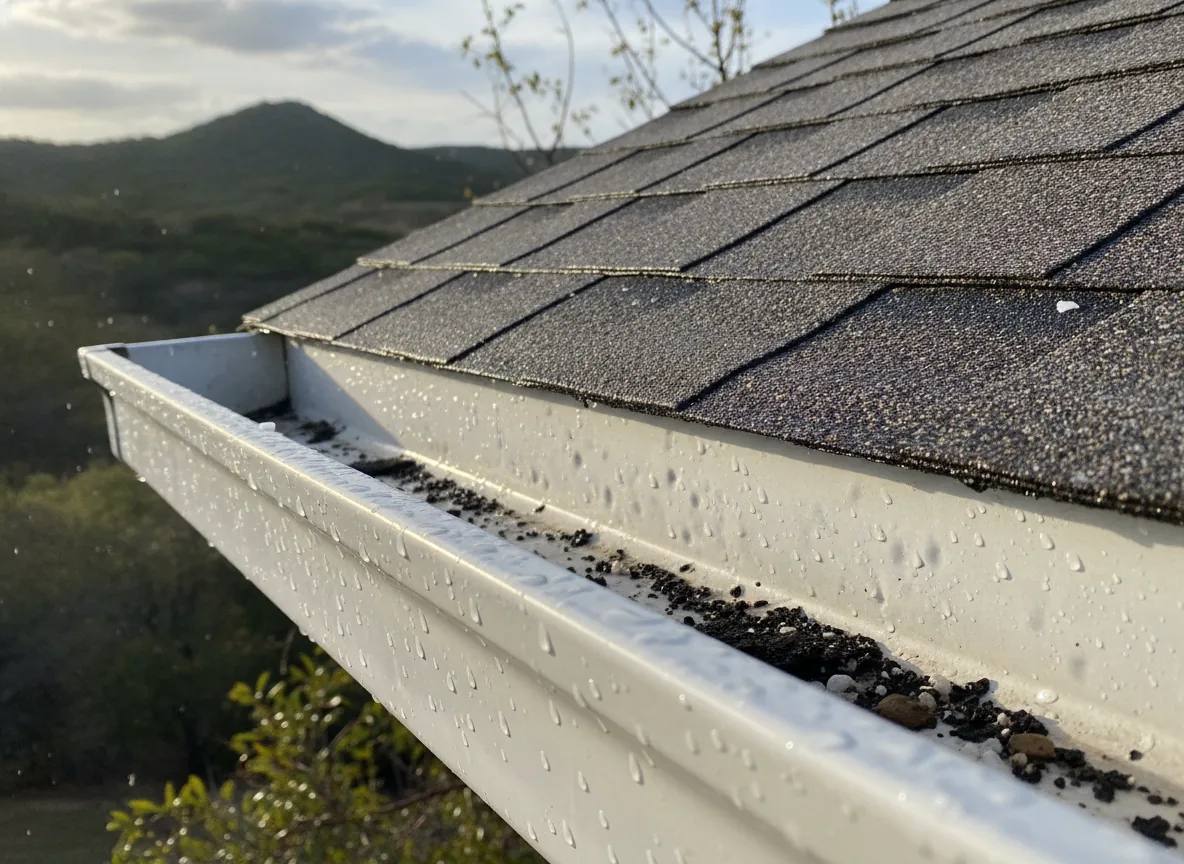
Hail dents on gutters and downspouts are often easier to see from the ground than damage on a roof you can’t see. After a storm, look for dents along the gutter’s top lip and face, crushed downspouts and dinged metal on A/C units, then photograph everything with the date. West Austin Gutters inspects storm-damaged gutters, documents the damage, gives you a written itemized estimate, and does the repair or replacement. We don’t handle your claim. Texas law is clear on that, and it protects you.
How to spot hail damage on gutters
Check from the ground first, and use binoculars for second stories.
- Dents on the top lip and front face. Wind can drive hail in at an angle, so check the front bead, the top edge and the face. Look along the gutter in low-angle light, early or late in the day.
- Dented downspouts. Downspouts are thin and often show round dents clearly. Crushed elbows can block flow.
- Gutters that now hold water. Dents in the bottom create low spots, and standing water means the slope is broken.
- Split seams and corners. Impact can crack sealant and open corners, so watch for new drips in the next rain.
- Bent hangers and gutters pulled from the fascia. Wind with the storm, or ice and limbs in winter storms, does this.
- Clues nearby. Dented A/C fins, dented mailboxes, spatter marks on painted surfaces and torn screens all help confirm that hail hit the house.
Dents on gutters can also point to roof damage. Gutters don’t prove it, but they’re a reason to have the roof inspected by a roofer.
How to document gutter damage for insurance
Good records make the claim easier, whatever you decide.
- Write down the storm date and time. You can look up hail reports in the Storm Prediction Center’s daily storm reports (quick, preliminary) and later in NOAA’s Storm Events Database (final, but it lags a couple of months).
- Photograph every side of the house. Take wide shots first, then close-ups.
- Show scale. Put a coin or a tape measure next to dents.
- Shoot in raking light. Dents show best with light coming from the side.
- Photograph downspouts, A/C units, fences and vehicles. Collateral damage helps show hail hit; pre-storm photos and storm reports help show when.
- Keep a log of any leaks, overflow or water inside after the storm.
- Read your policy for deductibles, deadlines and exclusions. Some policies exclude cosmetic hail damage; check whether yours names gutters or metal. Your insurer can tell you what yours says.
- Prevent more damage. If a gutter is hanging, a temporary fix may be covered by your policy (TDI says to make only temporary repairs). Keep receipts.
What we can and can’t do under Texas law
What we can do:
- Inspect gutters, downspouts, fascia and soffit, and photograph the damage
- Give you a written, itemized estimate for gutter repair or replacement
- Discuss our estimate and the technical details of the damage with your insurer or adjuster when you ask us to. The Texas Department of Insurance has said contractors may provide estimates and discuss them with the insurer.
- Do the work, whether insurance pays or you pay yourself
What we can’t do:
- Act as your public adjuster. Texas Insurance Code §4102.163 bars contractors from acting as public adjusters, or advertising to adjust claims, on property they’re working on or may work on. We won’t negotiate your claim, interpret your policy, or represent you to your insurer.
- Waive, pay or rebate your deductible. Texas Business & Commerce Code §27.02 bars contractors from waiving, absorbing or rebating an insurance deductible, including through discounts or allowances meant to cover it. Any contractor who offers to “cover your deductible” is offering to break the law.
- Inflate an estimate. Our estimate reflects the work the damage requires.
If you need someone to negotiate your claim, Texas licenses public adjusters for that. You can also work directly with your insurer.
Repair or replace after hail?
- Repair makes sense for a few dented downspout sections, one bent run, or a loose section. See gutter repair.
- Replace when dents run the length of the system, the gutters hold water, seams are opening up, or the damage is too widespread to patch evenly. See gutter replacement.
Hail-dented gutters can’t be popped back out reliably. Aluminum stretches when dented, so a “repaired” dent usually stays visible and the low spot stays.
When we replace, we usually recommend .032-inch aluminum over the thinner .027. It’s about 18% thicker and stiffer, though that doesn’t mean 18% more hail resistance. No gutter is hail-proof, and thickness alone doesn’t tell you how a gutter will fare in a given storm.
Austin’s hail and storm seasons
- Spring is peak hail. Central Texas large-hail season runs mainly March through May.
- Fall storms happen too. On September 24, 2023, NOAA records hail up to about 4 inches in Round Rock and 2.5 to 3 inches in north and central Austin.
- Ice storms bring limbs down. Winter Storm Uri (February 2021) and the January 30 to February 2, 2023 ice storm brought down limbs across Austin, bending and tearing gutters off fascia.
After a big storm, contractors from out of town often knock doors. Texas has no state license for gutter installers, so check for a written estimate, a local presence and the company’s details before you sign.
What affects the cost of hail damage gutter work
Every quote is written and itemized after we measure: linear feet, gutter size and material, number of stories, downspouts, guards and any fascia repair are listed as separate lines.
Cost factors:
- Linear feet and how much of the system is damaged
- Repair vs full replacement
- Gutter size and metal gauge
- Downspouts to replace
- Fascia damaged by impact or by water after the storm
- Stories and roof access
- Coordinating timing with a roof replacement
See the Austin gutter cost guide. Your deductible is yours to pay, by law.
FAQ
Can hail damage gutters?
Yes. Aluminum gutters and downspouts dent easily, especially the top lip, front face and downspouts. Larger hail can crush downspouts and split seams.
Is gutter damage covered by insurance?
Often, when it’s caused by a covered event like hail or a falling limb, but your policy decides. Deductibles, cosmetic damage exclusions and deadlines vary. Ask your insurer.
How do I know if my gutters have hail damage?
Look along the gutter in low side light for dents on the lip and face, check downspouts for round dents, and watch for new standing water or drips. Dented A/C fins nearby are another sign.
Should hail damaged gutters be repaired or replaced?
A few dents on downspouts can be repaired by swapping sections. Widespread dents, standing water and opening seams usually mean replacement, because dented aluminum can’t be smoothed back reliably.
Can a contractor pay my insurance deductible in Texas?
No. Texas Business & Commerce Code §27.02 bars contractors from waiving, paying or rebating your deductible. An offer to do so is a red flag.
Can my gutter contractor talk to my insurance adjuster?
Yes, about their estimate and the technical details. They can’t negotiate your claim or act as your adjuster under Texas Insurance Code §4102.163.
Can I fix hail damage on gutters without insurance?
Yes. If damage is under your deductible or you’d rather not file, we’ll quote the repair or replacement directly.
Get a hail damage gutter estimate
Quotes are free, written and itemized after we measure on site. We serve West Austin (West Lake Hills, Rollingwood, Tarrytown, Barton Hills, Bee Cave, Lakeway, Steiner Ranch, Oak Hill, Circle C, Dripping Springs) and the greater Austin metro from Georgetown to Kyle. We inspect storm-damaged gutters in Round Rock, Cedar Park, Leander and across the Austin area.
Book a free gutter quote. We measure on site and send a written, itemized quote.