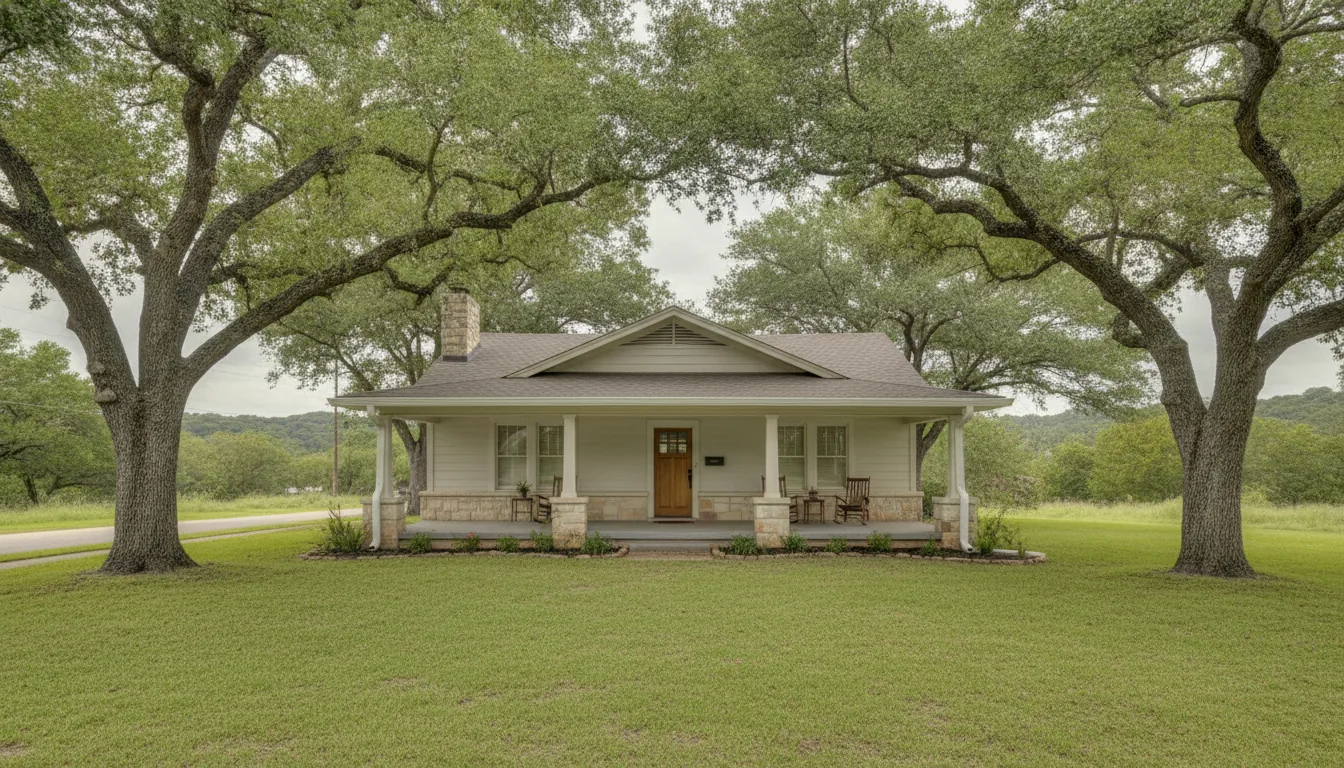
West Austin Gutters installs and replaces gutters in Tarrytown, Clarksville, Old West Austin, Pemberton Heights and Bryker Woods. These are some of Austin’s oldest neighborhoods: many houses date from the 1920s through the 1950s, and much of the area sits in National Register historic districts. Gutter work here means fitting gutters to older rooflines and wood trim, respecting the city’s historic review rules, and handling drainage on lots that keep getting tighter.
What gutters have to handle here
Old houses, old trim. Census estimates for ZIP 78703, which covers most of this area, put about 3 in 10 homes before 1950 and the median at about 1973. Bryker Woods was built out in the 1930s, the first Tarrytown section opened in 1934, and the Old West Austin district was developed between 1886 and 1953. On houses that age, the gutter is only as good as the fascia and rafter tails behind it.
Big trees over small roofs. Mature trees line the streets of these neighborhoods. Live oaks shed leaves and tassels mostly in March and April. Pecans and cedar elms drop in fall.
Creeks and the lake. Shoal Creek runs along the east side of Bryker Woods and Old Enfield and overflowed in Austin’s 1981 Memorial Day flood. Tarrytown runs west to Lake Austin. Before planning buried drainage near a creek, check your address in the city’s ATXFloodPro map.
Wildfire map. Austin’s 2025 wildfire map added neighborhoods just west of downtown to its risk zones. The rules cover new and remodeled buildings (and, per the city, repair and maintenance work in mapped zones), and a fire official warned that embers can land in gutters full of leaf litter.
Infill. Austin’s 2024 HOME amendments allow up to three units on many single-family lots, and smaller lots overall. When a new house or ADU goes up a few feet from an older one, roof water from both often ends up in the same narrow side yard.
Common gutter problems in homes like these
- Rotted fascia and rafter tails behind gutters that overflowed for years. These need fascia and soffit repair before new hangers go on.
- Mismatched add-ons: a modern K-style gutter on a 1930s house that originally had a different profile, or none at all.
- Downspouts discharging into a 5-foot side yard, right at both foundations, on lots where infill has removed the old drainage path.
- Partial systems, with gutters on the front porch only and the back roof draining straight onto the slab edge.
- Undersized outlets on older houses whose roofs were raised or expanded during remodels.
Recommended setup for older and historic homes
- Profile matched to the house. Half-round gutters with round downspouts suit many pre-war houses. K-style works on mid-century and newer homes. Aluminum is the usual choice. Copper is an option where the budget and the house call for it. See copper and half-round gutters.
- Trim repaired first, then hangers fastened into sound wood.
- Side-yard drainage planned with the neighbor in mind. Texas law prohibits diverting surface water in a way that damages a neighbor’s property. On tight lots, that often means a buried line to the front or back yard rather than a short extension. See downspouts and drainage.
- Fine-mesh guards where oaks and pecans overhang.
Historic review: when it applies
The City of Austin requires historic review for exterior alterations to city landmarks and to contributing properties in historic districts. That covers both local historic districts, like the Smoot/Terrace Park district in Clarksville (designated 2018), and National Register districts like Old West Austin and Clarksville. The city says routine maintenance and in-kind repairs don’t need review. Replacing gutters with the same type usually counts as in-kind. Changing the profile or material on a contributing house may not, so check with the Historic Preservation Office first. Separately, Austin’s list of work exempt from a building permit covers fascia and trim repair but doesn’t mention gutters, so we confirm permit needs with Development Services.
FAQ
Do I need historic approval to replace gutters in Old West Austin or Clarksville?
For like-for-like replacement, usually not. Austin exempts routine maintenance and in-kind repair from historic review. If your house is a contributing property and you’re changing the gutter style or material, check with the city’s Historic Preservation Office before ordering.
Are half-round gutters better for an older Tarrytown house?
They often look right on pre-war homes and drain well when sized correctly. They don’t automatically carry more water than K-style. On a large or steep roof, size and downspout count matter more than shape.
Where do downspouts go when the house next door is five feet away?
Usually into a buried line that carries water to the front or back yard, or to a spot where it can soak in or reach the street drainage legally. Dumping it at the property line just moves the problem to your neighbor’s foundation.
Do I need gutters if my older house never had them?
It’s a common question in Austin. The International Residential Code (R801.3, 2024 edition) calls for a controlled method of roof-water disposal where expansive soils are known to exist; how the city applies it, including any local amendment, varies. With closer neighbors and bigger additions, roof water has fewer places to go, so full gutters protect both the trim and the foundation.
Get an estimate in Central West Austin
Quotes are free, written and itemized after we measure on site. Every quote is written and itemized after we measure: linear feet, gutter size and material, number of stories, downspouts, guards and any fascia repair are listed as separate lines. Across Lake Austin and MoPac, we also work in West Lake Hills and Rollingwood.
Book a free gutter quote. We measure on site and send a written, itemized quote.