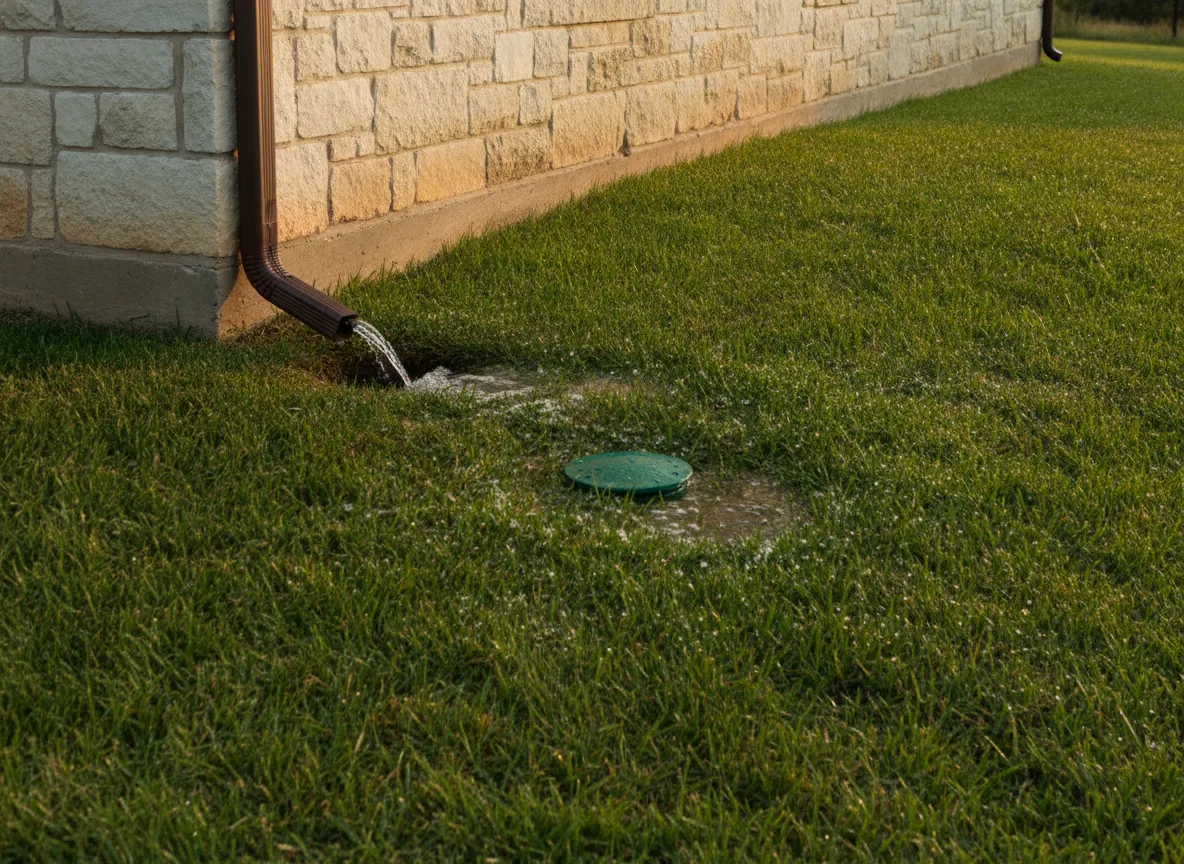
Every downspout should drop its water well away from the house, onto ground that slopes away, and never onto a neighbor’s lot. In practice that means an extension or splash block for easy spots, and a buried solid pipe to a pop-up emitter where water has to cross a walk, a bed or a flat yard. West Austin Gutters installs downspouts, extensions and underground downspout drains, and plans where the water ends up before we dig.
Where should downspouts drain?
Good discharge points:
- Onto ground that slopes away from the house, at least several feet out
- Into a buried solid line that runs to a pop-up emitter, a lower part of the yard, or a curb outlet where allowed (inside Austin that’s right-of-way work: it needs a city permit and a contractor with a right-of-way license)
- Into a rain barrel or cistern with an overflow routed the same way. See rainwater collection gutters.
Bad discharge points:
- Right at the foundation, which is how many builder installs end
- Into a low spot against the slab or a window well
- Onto a neighbor’s property, a shared side yard, or their driveway
- Into a French drain that was built to handle groundwater, not roof water
The International Residential Code (section R801.3, including the 2024 edition Austin adopted) calls for a controlled method of roof-water disposal where expansive soils are known to exist, such as discharging at least 5 feet from the foundation or into an approved drainage system. Local amendments and how your city applies it vary. We use 5 feet as our minimum target on clay lots.
Our downspout drainage options
Downspout extensions and splash blocks
The simplest fix. A rigid aluminum extension carries water several feet out, and a splash block keeps it from digging a hole. Flip-up hinged extensions let you mow around them. These work well where the ground already slopes away. Plastic snap-on extensions are cheap but often fall off or get crushed.
Underground downspout drains
Where an extension would cross a walkway or a bed, we bury the line:
- Plan the route and the endpoint. Water must end up somewhere lower than where it starts, on your property, draining away from buildings.
- Call 811. Utilities are located before any digging.
- Smooth-wall solid pipe. Our preference (not a code rule): smooth-wall solid pipe. Corrugated flex pipe traps debris in its ridges, sags in the trench and is hard to clean.
- Steady fall. The line slopes continuously toward the outlet so water and grit keep moving.
- Clean-out access. We add a clean-out or a debris filter at the downspout so the line can be flushed.
- Outlet. The line ends in a pop-up emitter, a daylight outlet on a slope, or another approved outlet.
Pop-up emitters
A pop-up emitter sits flush with the lawn. When water fills the line, the lid lifts and lets it out. When the rain stops, it closes. They work best with real fall from the house to the emitter. On a flat lot with dense clay, water can sit in the line, so we design for that or pick a daylight outlet.
Bigger downspouts and more of them
Sometimes the drainage problem starts at the top. A 3×4 downspout has about twice the nominal opening of a 2×3 (actual flow depends on the whole system), and adding a downspout to a long run splits the flow. We often pair drainage work with downspout upgrades on new seamless gutters.
Austin soil, slopes and drainage
Expansive clay. Clay soils that swell when wet and shrink when dry are common east of I-35 and in parts of the metro. Roof water dumped at one corner of a slab soaks that corner while the rest stays dry. Uneven movement like that can show up as cracks and doors that stick. Moving the water out and away, evenly around the house, is the goal.
Limestone and steep lots. In western Travis County, soils are thin over limestone, and lots are often steep. Water moves fast and erodes. Here, we focus on spreading water out at the outlet, using rock or splash pads, and avoiding concentrated streams down a slope toward the house below.
Heavy rain. NOAA’s Atlas 14 puts a one-hour rainfall rate at Camp Mabry around 2 inches in a typical two-year storm and about 3 inches in a 10-year storm. Underground lines and emitters must be sized so they don’t back up and spill at the downspout.
Closer houses. Austin’s HOME amendments (adopted 2023–24) allow up to three units on many single-family lots (Phase 1) and new small lots down to 1,800 square feet (Phase 2). Narrow side yards leave little room to discharge water without sending it next door. Buried lines that carry water to the front or back of the lot are often the only good answer.
Your neighbor’s runoff, and yours
Texas Water Code §11.086 makes it illegal to divert or impound the natural flow of surface water in a way that damages another person’s property. In plain terms: don’t point your downspouts at your neighbor, and don’t build something that ponds water onto their lot. If a neighbor’s downspouts or new driveway are flooding your yard, that same law may apply. Texas courts read “surface water” narrowly, so whether that law reaches water from a neighbor’s gutters depends on the facts; ask an attorney. Talk with them first, and get legal advice before relying on it.
We design every discharge to stay on your property and drain away from all buildings, including the neighbor’s.
What affects the cost of downspout drainage
Every quote is written and itemized after we measure: linear feet, gutter size and material, number of stories, downspouts, guards and any fascia repair are listed as separate lines.
Cost factors:
- Number of downspouts being connected
- Length of each buried run and the trench depth
- Digging conditions: clay, rock and roots are slower than loam
- Crossing walkways or driveways
- Pop-up emitters, clean-outs and debris filters
- Restoring sod, mulch or rock after trenching
- Downspout upgrades from 2×3 to 3×4
See the Austin gutter cost guide for more.
Downspout drains vs French drains vs regrading
- Downspout drains move roof water from a known point to a known outlet. Start here if your gutters dump at the foundation.
- French drains collect water that seeps through soil or across the yard. They’re a landscape drainage job, and roof water piped into them can overwhelm them.
- Regrading fixes soil that slopes toward the house. If the ground around your slab is flat or reversed, extensions alone won’t solve pooling.
We handle the downspout side. For yard-wide drainage or regrading, we’ll tell you when you need a drainage or landscape contractor.
FAQ
Should downspouts be buried?
Bury them where an above-ground extension would be a trip hazard, get mowed over, or can’t reach a good outlet. Use solid pipe with steady fall and a clean-out. If the ground already slopes away, a simple extension works fine.
How far should a downspout drain from the house?
The model building code (IRC R801.3, 2024 edition) calls for at least 5 feet from the foundation where expansive soils are known to exist, or into an approved drainage system, and we use that as a minimum. Farther is better on flat clay lots, as long as the water stays on your property.
Do downspout extensions work?
Yes, when the ground slopes away and the extension stays attached. They fail when they’re crushed, disconnected or end in a low spot that drains back toward the house.
Can downspouts drain into a French drain?
It’s usually a bad idea. A French drain is built to absorb slow groundwater, and roof water in a storm arrives fast and carries grit that clogs it. Run downspouts in their own solid pipe instead.
Do pop-up emitters work in clay soil?
They work if the line has real fall to the emitter. On flat clay lots, water can sit in the pipe between storms. A daylight outlet on a slope or a clean-out to flush the line helps.
What can I do about my neighbor’s downspouts flooding my yard?
Start with a conversation. Texas Water Code §11.086 bars diverting surface water in a way that damages a neighbor’s property, though courts read “surface water” narrowly. A drainage fix on their side is usually cheaper than a dispute. Get legal advice if it doesn’t resolve.
Get a downspout drainage quote
Quotes are free, written and itemized after we measure on site. We serve West Austin (West Lake Hills, Rollingwood, Tarrytown, Barton Hills, Bee Cave, Lakeway, Steiner Ranch, Oak Hill, Circle C, Dripping Springs) and the greater Austin metro from Georgetown to Kyle. We install downspout drains on clay soils in Pflugerville and Hutto, and on sloped lots in Oak Hill.
Book a free gutter quote. We measure on site and send a written, itemized quote.