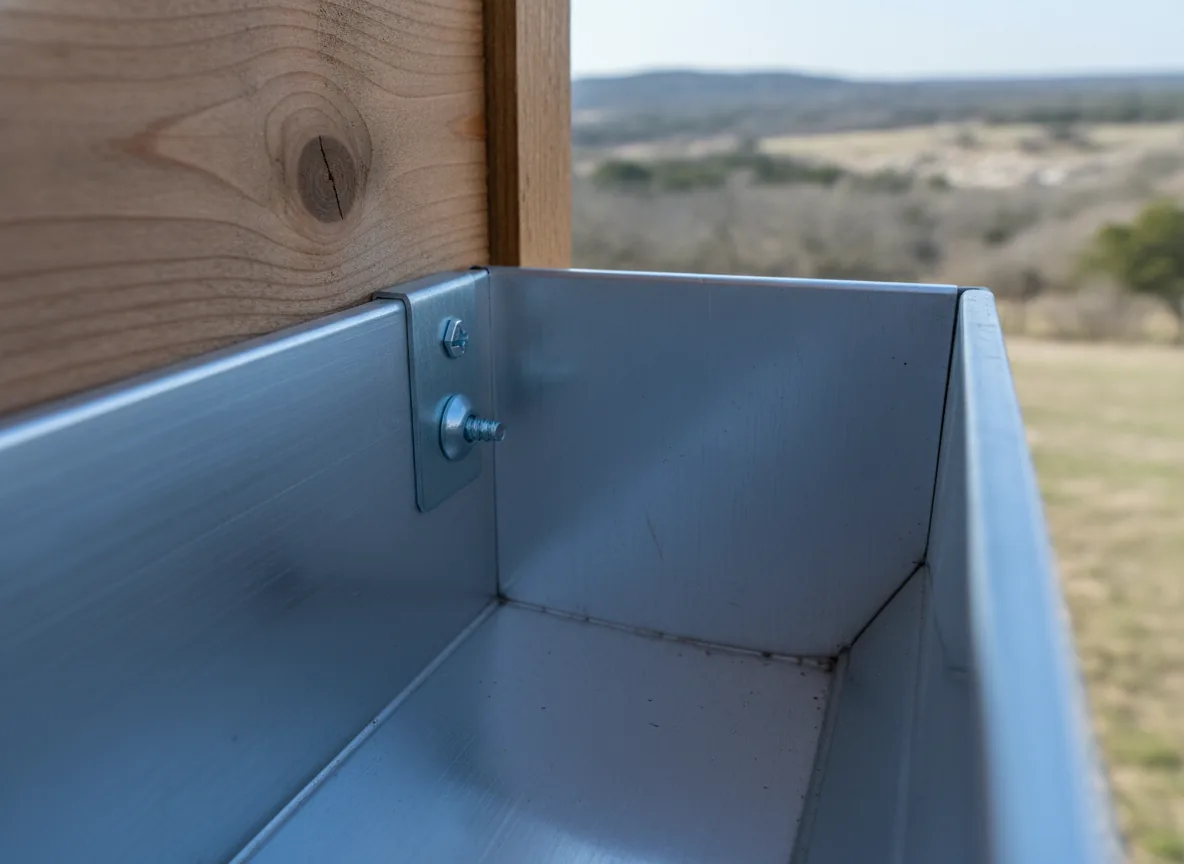
Replace your gutters when the problems are system-wide: sagging along whole runs, leaks at many seams, rust or splits, gutters too small for the roof, or hail dents that hold water. If the trouble is one corner or one loose section, a repair is usually the better buy. West Austin Gutters will tell you which one you need and put the reason in writing.
Gutter repair vs replacement: how to tell
Repair usually makes sense when:
- One or two corners leak, and the rest of the system is sound
- One section sags because a few hangers pulled out
- A downspout is crushed or disconnected
- The gutters are the right size and mostly sound (no widespread leaks, rust-through or sagging)
Replacement usually makes sense when:
- Leaks show up at seams all along sectional gutters
- Sagging repeats after rehanging, often because the fascia is soft
- The metal is rusted through (steel), cracked (vinyl), or badly dented
- The gutters overflow in normal storms even when clean, meaning they’re undersized
- You’re replacing the roof or fascia anyway
If a company tells you to replace a system you thought needed a repair, ask them to show you why. We’ll photograph the problem and explain the call either way. See gutter repair for what we fix without replacing.
What a full gutter replacement includes
Tear-off and inspection
We remove the old gutters, hangers, downspouts and straps, and haul them away. With the gutters off, we can see the fascia board. This is when rot shows up. We photograph it and price any fascia work before we go further. We will not hang new gutters over rotten wood. See fascia and soffit repair.
Re-measure and resize
A replacement is the chance to fix sizing mistakes. Many older Austin systems are 5-inch gutters with 2×3 downspouts, which struggle with our short, heavy storms. NOAA’s Atlas 14 puts a 5-minute burst at Camp Mabry at about 6.3 inches per hour in a typical two-year storm. We size each run to the roof area and pitch feeding it:
- 5-inch K-style for small, low-pitch sections
- 6-inch K-style for most Austin homes, especially with valleys or long runs
- 7-inch for large roof areas or very steep, tall roofs
New seamless gutters
We form new seamless gutters on site in .027 or .032-inch aluminum. We recommend .032 where hail, ladders or long spans are a concern. Gutters are hung with screw-in hidden hangers, typically about every 24 inches, closer under valleys.
Slope, seams and outlets
We set a slight fall toward each outlet, set to the gutter maker’s spec (gutter makers publish minimums from 1/4 inch per 10 feet to 1/16 inch per foot). Long runs slope both ways from the middle to two downspouts. Corners and end caps are riveted and sealed inside with gutter-grade sealant.
New downspouts and discharge
Yes, replacement includes downspouts. We usually upgrade from 2×3 to 3×4 downspouts, which have about twice the nominal opening (actual drainage depends on the whole system). We add outlets where one downspout was serving too much roof, and we finish each one so water lands well away from the foundation. See downspouts and drainage.
Gutter apron or drip edge check
We check that water coming off the shingles lands in the gutter, not behind it. Where it doesn’t, we add a gutter apron without breaking the shingle seal, or rehang the gutter so the edge drains into it. That’s gutter-adjacent trim, not roofing.
Why Austin gutters wear out
Hail. Central Texas large-hail season peaks March through May, with a second risk in fall. On September 24, 2023, NOAA records hail up to about 4 inches in Round Rock and 2.5 to 3 inches in north and central Austin. Dented gutters hold water, sag and leak at seams. See hail damage gutters.
Ice and falling limbs. Winter Storm Uri in February 2021 and the ice storm of January 30 to February 2, 2023 brought down limbs across Austin. Many gutters are still bent or pulled loose from those events.
Heat cycling. Long summers make aluminum expand and contract daily. Spike-and-ferrule hangers on older homes work loose over time.
Clay soil and settling. East of I-35 and in parts of the metro, expansive clay moves with moisture. Gutters dumping water at the foundation add to that movement, which is one reason a full system with proper discharge matters.
Age and patching. A system that has been resealed and rehung many times often has soft fascia behind it. Patches buy time, but each one adds another seam to fail.
What affects the cost of gutter replacement
Every quote is written and itemized after we measure: linear feet, gutter size and material, number of stories, downspouts, guards and any fascia repair are listed as separate lines.
Cost drivers for a replacement:
- Linear feet, corners and number of stories
- Gutter size and metal gauge
- Number and size of downspouts, and any buried drain lines
- Tear-off and disposal of the old system
- Fascia boards that need replacing once the old gutters come off
- Gutter guards, if you add them at the same time
- Roof access: steep pitches, tall walls, landscaping and decks below
See the Austin gutter cost guide for the full breakdown.
Should you replace gutters with a new roof?
Not always, but timing matters. A roofer installing new shingles may need to remove gutters or will work around them. If your gutters are near the end of their life, replacing them right after the roof avoids paying to remove and rehang old ones. The usual order is roof, then any fascia or rot repair, then paint, then gutters. That way new gutters aren’t taken down for painting.
If your gutters are newer and sound, they can usually stay. Ask the roofer to protect them, and have them checked for hidden dents and loosened hangers afterward.
FAQ
How often should gutters be replaced?
There’s no fixed schedule. Lifespan depends on metal thickness, installation, trees and storms, and there’s no reliable local data on how long gutters last in Austin. Replace them when leaks, sagging, rust, hail dents or undersizing are spread across the system, not just in one spot.
Does gutter replacement include downspouts?
It should. Ours does. Old downspouts are often too small, dented inside or poorly connected, and reusing them can undo the benefit of new gutters. Check that every quote lists downspout size and count.
Do gutter companies replace fascia?
Many do, including us. Rotten fascia is common behind old gutters, and new gutters must be screwed into sound wood. We price fascia repair separately after the old gutters are off, with photos.
Do gutters need to be replaced with a roof?
Only if they’re worn out or the roofer can’t work around them. If they’re due anyway, doing them right after the roof saves a remove-and-rehang. Sound gutters can stay.
Is gutter replacement covered by insurance?
Sometimes. Damage from a covered event like hail or a falling limb may be covered, while age and wear usually aren’t. Your policy decides. Read our hail damage page for what to document.
What is the difference between gutter replacement and new gutter installation?
Replacement adds tear-off, disposal and a fascia inspection to the job. Otherwise the new system is built the same way as a first-time seamless gutter installation.
Get a gutter replacement quote
Quotes are free, written and itemized after we measure on site. We serve West Austin (West Lake Hills, Rollingwood, Tarrytown, Barton Hills, Bee Cave, Lakeway, Steiner Ranch, Oak Hill, Circle C, Dripping Springs) and the greater Austin metro from Georgetown to Kyle. We work in older neighborhoods like Tarrytown and Barton Hills, and in suburbs like Pflugerville.
Book a free gutter quote. We measure on site and send a written, itemized quote.